Nobody’s race
Tadej Pogačar won the five editions of Il Lombardia from 2021 to 2025, each time arriving alone in Como. The sixth was always going to be different, because the injuries from his Vuelta crash had ended his season. The 120th edition, 239 km from Bergamo to Como with 4,662 metres of climbing, was left to a field of riders who had been waiting for exactly this chance:
- Remco Evenepoel, the European champion and the top favourite
- Isaac del Toro, who had spent the week talking about a sore knee
- Brandon McNulty, in his first Monument in the rainbow jersey
- Tom Pidcock, second at the Emilia and second at the Tre Valli on Tuesday
- Enric Mas, the Vuelta champion
- Giulio Ciccone, in his last race for Lidl–Trek
- Paul Seixas, seventh here last year, who had skipped the Europeans to arrive fresh
The course was essentially the 2022 route. There was no Muro di Sormano. The early climbs were Selvino and three big-ring ascents, followed by the Madonna del Ghisallo out of Bellagio: 8.6 km at 5.4%, with 10–15% ramps at the bottom. After that came the Como finale: San Fermo della Battaglia, the Civiglio (4.2 km at 9.7%, a long straight ramp and then ten hairpins), San Fermo again, and the descent to the lake.
Five minutes in Bergamo
At 11:00 the peloton lined up in Bergamo and refused to start. The riders held a five-minute strike, and they had several reasons:
- Two months earlier, Finlay Tarling was killed at the Volta a Portugal when a member of the public drove a truck onto the course against the race.
- On Tuesday at the Tre Valli, a police motorbike drove the wrong way into Thomas Gloag and Marcel Camprubí.
- On Monday at the Coppa Bernocchi, a delivery van got onto the course behind the break.
Evenepoel took the microphone and spoke for the riders: “This is a statement to the whole world that riders keep dying in races. We are holding a five-minute strike to send a message to race organisers. We are asking for safer races so that we can continue racing in the future.” RCS’s press release afterwards said the riders had stopped “to urge all road users to behave responsibly and show mutual respect”, even though the protest was aimed at race organisers. Before the strike there had been a gentler ceremony: a guard of honour for Bauke Mollema, Pello Bilbao, Ion Izagirre, Rudy Molard and Odd Christian Eiking, all starting the last race of their careers.
Fourteen up the road, three Americans on the Ghisallo
A group of thirty went clear on the early slopes of Selvino. That was too many for UAE and Decathlon, who chased it down. Johannes Kulset (Uno-X) countered, and that move stuck with twelve riders, which became fourteen when two more bridged across:
- Ben O’Connor (Jayco AlUla)
- Victor Campenaerts (Visma | Lease a Bike)
- Antonio Tiberi (Bahrain Victorious)
- Michael Leonard (EF)
- Maxime Decomble (Groupama-FDJ)
- Sylvain Moniquet (Cofidis)
- Fausto Masnada (MBH Bank)
- George Bennett (NSN)
- Pau Martí (NSN)
- Louis Vervaeke (Soudal Quick-Step)
- Gijs Leemreize (Picnic PostNL)
- Julien Bernard (Lidl–Trek)
- Andrea Mifsud (Polti VisitMalta)
- Johannes Kulset (Uno-X)
The gap never grew much beyond three minutes, because none of the favourites’ teams was going to let a Monument go up the road. O’Connor’s pace had cut the break to seven by the Ghisallo. On the way there, RAI reported that Enric Mas had stopped in a tunnel with stomach trouble; the Italian commentary called it a problem à la Dumoulin. Keep that in mind.
On the Ghisallo, Giulio Pellizzari set a hard pace for Evenepoel’s Red Bull–BORA–hansgrohe. Visma then took over, and Matteo Jorgenson attacked, followed by McNulty, Quinn Simmons and Christian Scaroni: three Americans and an Italian. For a few kilometres the move looked promising, because UAE had no reason to chase with the world champion in it. But it never gained even fifteen seconds. Red Bull and Decathlon still had riders working, and about forty were together over the top.
The first San Fermo
When the race reached Como, the break was down to six riders with 1:30 in hand. Pellizzari led the bunch up the first San Fermo with Seixas, Evenepoel, Ciccone, Pidcock, Del Toro and McNulty all well placed. Behind them the group came apart: Primož Roglič, Jorgenson, Lenny Martinez and Juan Ayuso were all dropped before the top, and Tiberi fell out of the break. Then came the descent, the run along the lake, and the foot of the Civiglio.
The Civiglio
On television, Seixas’s move barely looked like an attack, and the riders behind him said it hadn’t felt like one either. About 18 km from the line, on the long straight ramp at the bottom of the Civiglio, he went to the front and raised the pace without leaving the saddle. McNulty was on his wheel and began shaking his head. Here is how the group came apart:
- A full minute after he went to the front, Seixas stood on the pedals for the first time, and McNulty and Del Toro were dropped.
- Evenepoel had already chosen to ride his own tempo, and he was losing ground doing it.
- Pidcock fought his way onto the wheel, pushing a big gear and rocking to stay there. Ciccone went with them, and Mas was a few metres behind, riding to his power meter.
- About a minute later Seixas accelerated out of the saddle again, and Pidcock cracked with roughly two kilometres of the climb left.
- Ciccone held on a little longer before he was dropped too.
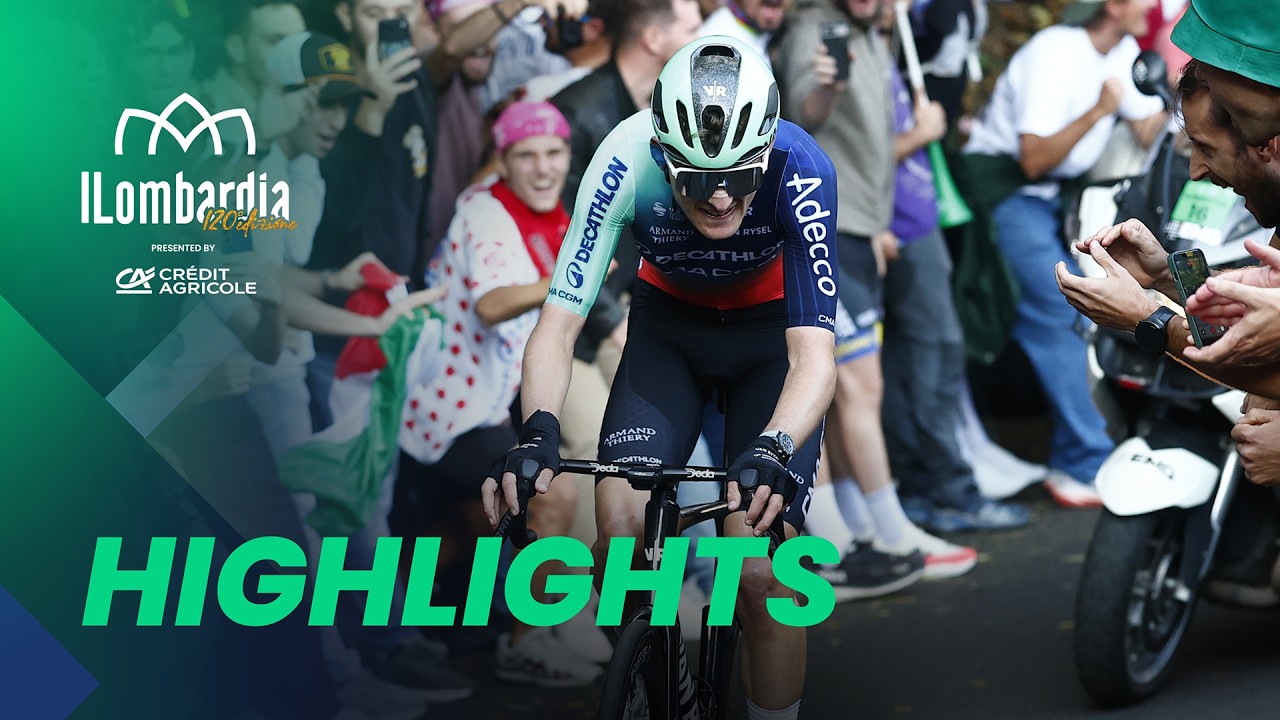
Seixas caught and passed the last of the breakaway; Canada’s Michael Leonard was the final survivor. By the summit Seixas was alone with about twenty seconds’ lead, and he had climbed the Civiglio more than half a minute faster than Pogačar’s best time.
“I don’t think he really attacked,” Pidcock said. “He just kind of made his own pace, a high pace. He was super strong. I made a bit of an effort to come to the front, went a little bit deep, got onto Paul’s wheel and paid for it.” Seixas thought he had gone too soon: “I felt like the rhythm was not high enough at the start of the climb – for me at least – to make the difference. So I had to accelerate early, maybe a bit too early.”
Me against myself
After the Civiglio there was a descent into Como, a few flat kilometres through town, one more climb of San Fermo (2.8 km at 6.9%), and the final drop to the lake. That terrain suited a time triallist, and Seixas took Worlds time trial bronze in Montréal three weeks ago. He had 35 seconds at the foot of San Fermo with a little under 8 km to go, and nearly 50 at the top. The chase behind him slowly reshuffled:
- Mas, who had stopped in that tunnel two hours earlier, rode up to Ciccone at his own measured pace and dropped him in the final kilometre of San Fermo.
- Ciccone held off everyone else for third.
- Seven riders finished together at 1:20, and Evenepoel won their sprint for fourth by a wide margin.
Seixas had been told his lead was 30 to 40 seconds, and he didn’t let himself believe he would win until the top of the last climb. “Then I did the best I could, a TT, me against myself,” he said. “At the end of the last climb I started believing and I just had to not make mistakes on the downhill.” He made none. He crossed the line in Como in 5 hours 49 minutes 28 seconds, 48 seconds ahead of Mas and 1:05 ahead of Ciccone.
Twenty years and sixteen days
Giovanni Gerbi was 20 years and 161 days old when he won the first Giro di Lombardia in 1905. For 121 years nobody won it younger, through the eras of Coppi, Merckx, Hinault and Pogačar’s five wins. Seixas was born on 24 September 2006 and won at 20 years and 16 days. He was still 19 when he took Del Toro to the line in Montréal and when he won that time-trial bronze. He turned 20 in the same week as the Worlds road race, where he cramped out of the lead group.
This was his eighth win of the season. His year so far:
- won the Flèche Wallonne
- won the Tour of the Basque Country
- second at Liège
- fourth at the Tour de France on his debut
He is the first French winner of Lombardia since Thibaut Pinot in 2018, when Seixas was twelve. It is also the first Monument ever for Decathlon CMA CGM or any team it grew out of. The team’s best Monument results before today were three second places: Alberto Elli at Milan–San Remo in 1998, Silvan Dillier at Roubaix in 2018, and Seixas himself at Liège in April.
When asked about the record, he dismissed it: “I don’t really care about being the youngest or whatever, I just care about winning. Today I won a Monument and that’s beautiful, that’s all I will remember.” When asked, inevitably, about Pogačar, he answered carefully: “I won a Monument Classic but to beat Tadej is something else. Maybe I will never beat him but I will always try. If you don’t try, you will never succeed.” He plans to race the Roc d’Azur mountain bike event tomorrow, which would be his fiftieth race day of the year. His road season is over.
The top ten
- Paul Seixas (Decathlon CMA CGM) — 5:49:28
- Enric Mas (Movistar) — +0:48
- Giulio Ciccone (Lidl–Trek) — +1:05
- Remco Evenepoel (Red Bull–BORA–hansgrohe) — +1:20
- Brandon McNulty (UAE Team Emirates–XRG) — s.t.
- Tom Pidcock (Pinarello–Q36.5) — s.t.
- Pello Bilbao (Bahrain Victorious) — s.t.
- Christian Scaroni (XDS Astana) — s.t.
- Filippo Zana (Soudal Quick-Step) — s.t.
- Mathys Rondel (Tudor) — s.t.
In the grupetto
Mas was second here in 2022 as well, behind Pogačar on this same course. Two hours after stopping in a tunnel, he rode the finale entirely by his numbers: “I had my numbers, so I was confident and I followed the numbers. Maybe somebody like Paul can drop me, but I was confident in that.” On finishing second again: “Another time second here, so yeah, happy.” He had surgery last year and couldn’t train for four months, and he has now won the Vuelta and finished on the Lombardia podium.
Ciccone was in his last race for Lidl–Trek and on what he called a bad day, and he still made the podium. “Honestly, on the podium when they said 20 years old, I was shocked,” he said. “I just remember when I was 21, I won my first stage in the Giro and it was something super, super big.”
Bilbao finished seventh in the last race of his career, an excellent way to go out. Mollema, Izagirre, Molard and Eiking also retired today.
Evenepoel led the strike in the morning, rode his own tempo up the Civiglio, and won the sprint for fourth. “I didn’t come here for fourth place,” he said. “But there wasn’t much more in it.” He has one race left this season, the Chrono des Nations next week: “three quarters of an hour, and then it’s done.”
Jorgenson attacked on the Ghisallo (“We tried some fun tactics and we weren’t favourites for the race because it’s just such a hard and honest race. So we had to go long”) and was dropped on the first San Fermo. He finished his season sounding more relieved than disappointed: “What a place to finish the season. In Como, next to a lake, beer in my hand. It doesn’t really get better.”
Moral of the story
The Civiglio has been the decisive climb of this race for years, and the usual way to win on it is to attack. Seixas never really did. He decided the pace was too slow and raised it, one minute at a time, until he was the only rider left. The grupetto’s moral: an attack gives you a moment to respond; a pace nobody can hold gives you none. For five years this race belonged to Pogačar. Next October he will be back, and for the first time since 2020 he will start in Bergamo as the challenger.
Sources
- The Inner Ring: Il Lombardia 2026 review and preview
- PezCyclingNews: Seixas Storms to His First Monument
- Escape Collective: Seixas seizes the spotlight in first Monument victory, Seixas vows to keep improving after landmark win and Peloton unites to delay Il Lombardia start
- IDL Pro Cycling: Paul Seixas becomes youngest ever Il Lombardia winner and live coverage
- Domestique: Seixas makes history as youngest winner of Il Lombardia
- dpa via Yahoo Sports: Frenchman Seixas becomes youngest Il Lombardia winner
- CyclingUpToDate:
- Finish-line interviews: Cycling Pro Net (embedded above)