The short version
We stood on Mont Royal for all twelve laps of the men’s road race, came home, and spent a week arguing with ourselves about what we’d seen. The argument fits in a Short — just about — so that is where it went first. The longer version, with the numbers attached, is below.
The best team won, not the best rider
Start with the thing that got lost under the fireworks: the United States did not win the Worlds because Brandon McNulty was the strongest rider in Montréal. It won because, for once, eight Americans rode like one country. The squad was McNulty, Quinn Simmons, Matteo Jorgenson, Sean Quinn, Kevin Vermaerke, Artem Shmidt, Larry Warbasse and Riley Sheehan, and the plan was written by a rider, not a federation: Jorgenson, training in Vermont the week before, put together the kind of tactical document his trade team usually hands him, and sent it to the others himself. Coach Michael Creed added one rule for the circuit — at all times, Americans should make up at least a tenth of the front group — and the night before the race the three leaders agreed on the only thing that mattered. “We set our egos aside a little bit,” Jorgenson said afterwards, “and we decided, okay, we just want an American to win this race.”
Then they did it, in order. Simmons went with Van Aert and Van der Poel at 87 km and stayed there when the Dutchman accelerated again, which meant McNulty and Jorgenson could sit in while Mexico and France burned matches chasing. When it all came back together with two and a half laps left, there were three Americans in a front group of about a dozen — no other nation had three — and McNulty went off the last wheel at 32 km. “When we had Quinn ahead, it allowed me and Matteo to follow,” he said. Behind him, Jorgenson spent the last hour as the most annoying man in the race: every time a favourite jumped, a stars-and-stripes jersey was on his wheel, and nobody wanted to chase a world title only to tow an American into the sprint. Simmons fourth, Jorgenson eighth, McNulty in the rainbow jersey. Three in the top ten. In 1982 at Goodwood, Greg LeMond and Jonathan Boyer wore the same jersey and raced each other for a medal; in Montréal, forty-four years later, the Americans finally raced as a team, and it is not a coincidence that it was the first time since Armstrong in 1993 that it worked.
The loudest name on the mountain wasn’t American
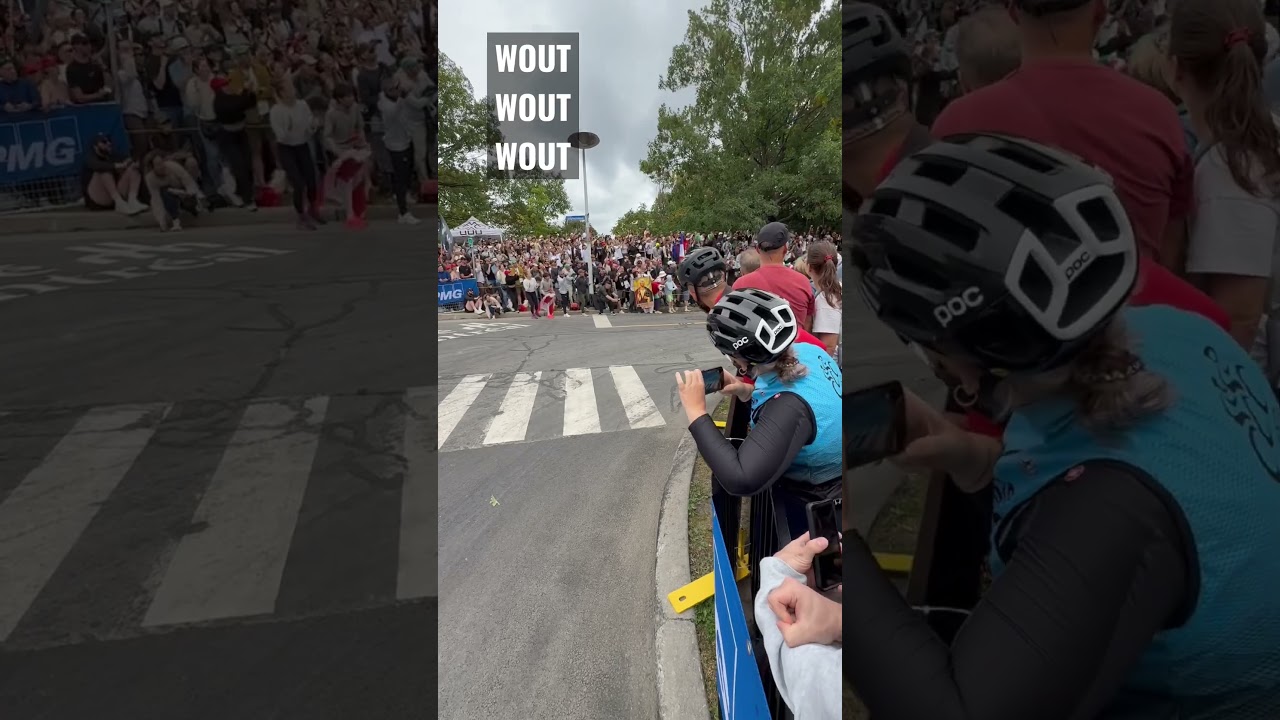
Here is the other thing we brought home from the fences. The rainbow jersey went to Phoenix, but the crowd belonged to Wout van Aert. Every lap, on every corner of Camillien-Houde we stood on, the name came up the hill before he did — three syllables, chanted, from Belgians in Montréal and Québécois who’ve adopted him and people who had simply decided that he was the one to cheer for. He was in the six-man move at 85 km, got gapped, came back, and spent the final laps riding for Evenepoel instead of himself. Nobody cared. Twelve laps of a race he didn’t win, and the mountain roared for him every time. We filmed one of them.
That tells you something about what fans actually want from bike racing, and it isn’t only winners. Van Aert loses more big races than he wins, and he loses them in front, which is the whole point. The sport in North America could do worse than remember that when it tries to sell itself.
The state of the union
Which brings us to the awkward part. A rainbow jersey is a result. It is not a system. The Tour of California — the race that was supposed to be the American rider’s bridge to Europe — has been dead since 2019. The Tour of Utah went. The Colorado Classic went. The Maryland Cycling Classic, the race that was going to replace all of them, went too. There are two American-registered teams in the WorldTour, EF Education–EasyPost and Lidl–Trek, and both spend the overwhelming majority of their seasons in Europe, because that is where the racing is. An American kid who wants to be a professional road racer now leaves home at eighteen or doesn’t become one. McNulty himself is the exception that explains the rule: he spent three seasons at Rally because his junior coach, Roy Knickman, decided to make cycling “palatable” for a teenager who didn’t need to be thrown into the European meat grinder at seventeen — and Rally no longer exists either. Creed, the coach who drew up the ten-percent rule, built his own long career on an American domestic scene that has since mostly stopped existing.
So the honest reading of Montréal is this: the United States has, right now, the deepest generation of men’s road talent it has produced in thirty years — McNulty, Jorgenson, Simmons, Sepp Kuss with a Vuelta already on the shelf — and almost nothing underneath it. The jersey can’t fix that. What it can do is sell. There is a window: Philadelphia is back on the calendar, Battenkill is on the UCI calendar for the first time in thirteen years, the Gila survives, and in July 2028 the Olympic road race starts on the Venice Beach boardwalk and finishes at the Griffith Observatory with the whole of Los Angeles watching. A world champion in the stars and stripes in the run-up to a home Olympics is the best sales pitch American cycling has had since the sport last tried, and failed, to turn a star into a structure. The question is whether anyone with a chequebook is listening this time.
In the grupetto
The five who didn’t make the television: Quinn, Vermaerke, Shmidt, Warbasse and Sheehan, who rode the 100 flat kilometres from Brossard as a wall around three leaders, then peeled off one by one as the circuit took its tax. Warbasse put it simplest afterwards: if they had the perfect day, any of the three could win, and it was the perfect day. Sheehan, who had been left off the team and said so publicly, then got the call when Neilson Powless was out, and rode anyway. And the thousands who stood on that mountain without a flag that mattered to the result, chanting a Belgian’s name for six hours. They were the race too.
Moral of the story
The best bike racers in the world lined up in Montréal without radios, and the country that won was the one that had decided, the night before, that it was a country. The grupetto’s moral: talent gets you into the front group; agreeing who you are gets you across the line. America has the talent. For one afternoon it had the agreement. Whether it ever gets the calendar, the teams and the pathway to go with them is the question we’ll still be asking at Venice Beach in 2028. Press play. Then go find a bike race to stand beside.