A championship with a crash in it
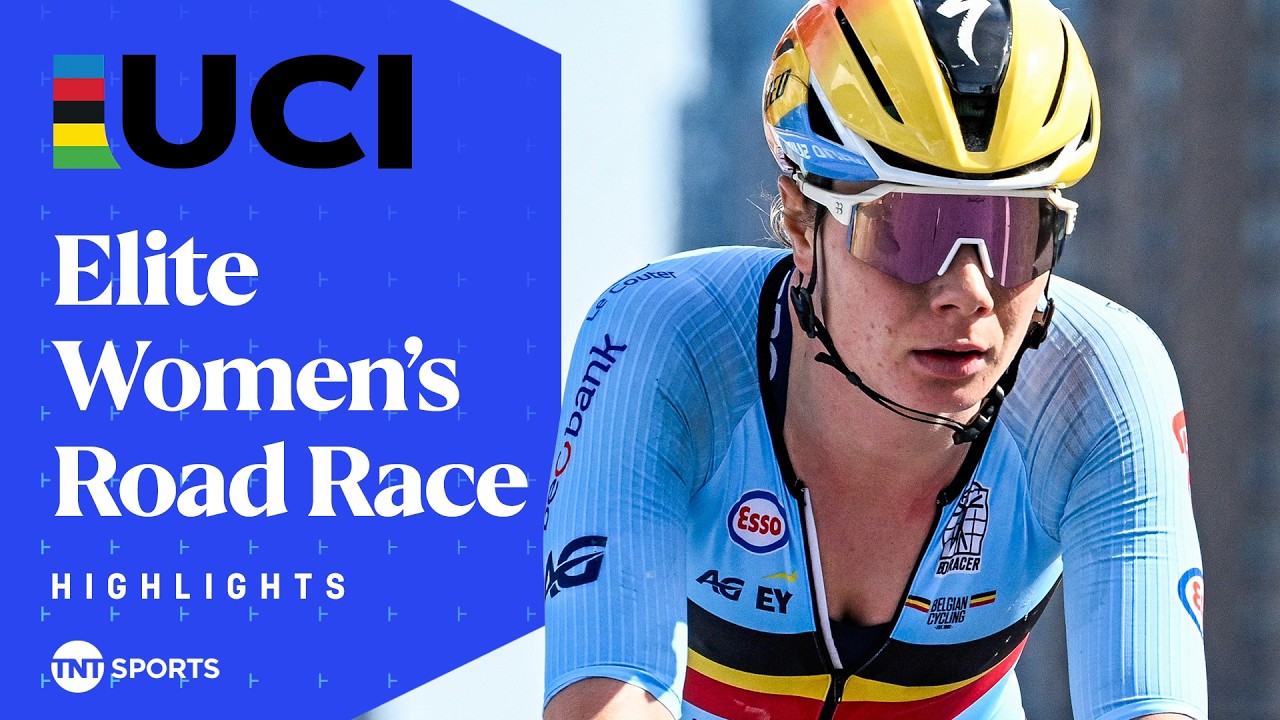
The elite women got the mountain first. 180.1 km from Brossard, a 73 km run-in over the river and then eight laps of the 13.4 km Mont Royal circuit — Camillien-Houde, Polytechnique, the rise to Pagnuelo, 2,570 metres of climbing in all — the same roads where Del Toro beat Seixas a fortnight ago and where we stood on the fences to watch it. Marte Berg Edseth and Natalie Quinn took the early break out to five minutes and were swept up with 67 km left. But the race’s first decisive moment came far earlier and far uglier: on the first full lap, 94 km from the finish, a wide descent on Rue Saint-Urbain took down around sixteen riders. Lauretta Hanson and Caroline Andersson went to hospital; Julia Borgström stopped to help her Swedish teammate and climbed off in tears; Paula Blasi, down for the second time in the day, abandoned; Niamh Fisher-Black, last year’s silver medallist, was gone too; Kim Le Court-Pienaar was stranded behind the split. And Magdeleine Vallières Mill — the defending champion, on home roads, with the whole of Québec on the barriers — got back on bleeding from a leg and a hand, rode a full lap so the finishing straight could roar for her, and then climbed off. The peloton that survived it numbered fewer than forty.
Pieterse pulls the pin
Maeva Squiban lit the fuse on Camillien-Houde with 52 km to go and built 45 seconds alone, which was enough to make the Netherlands stop waiting. With three laps left, Puck Pieterse took the climb at a pace that dismantled the group, and near the summit Demi Vollering went — across to Squiban, past her, and away. Marlen Reusser, the woman most capable of pulling that back on the flat, was fumbling a bottle at exactly the wrong moment: “I missed the decisive attack. I’m especially furious with myself.” Vollering was alone for nearly two laps with a gap that never quite grew into safety, and by her own account spent most of them convinced she’d gone too early. With roughly 15 km to go the chase — Elisa Longo Borghini, Kasia Niewiadoma-Phinney and Juliette Berthet — made contact, Reusser dropping off the back of it on the climbs. “At one point they came back, and I was like, ‘Oh shit,’” she said afterwards. “But it’s still not over.”
The bell, the Italian and the sprint
It wasn’t. Longo Borghini attacked straight through the finish line at the bell — no feint, no looking round — and opened ten seconds into the last lap. Vollering, having just been caught, had every excuse to let someone else chase. Instead she took the final Camillien-Houde on the front with Niewiadoma-Phinney glued to her wheel, closed the Italian down over the top, and then simply went on climbing until Longo Borghini couldn’t. From there the two women who’d spent August trading blows across France worked together to keep the Italian and a rallying Reusser at bay — and then, inside the last few hundred metres, stopped working, slowed to a crawl and dared each other. Niewiadoma-Phinney jumped first, inside the final 200 metres, on the rise to the line. Fifty metres out her legs cramped. Vollering came past and didn’t look back. Longo Borghini rolled in four seconds later for bronze, Reusser four seconds after that, Berthet at 39 seconds. “I was not planning to give it away anymore from that moment,” Vollering said. “I was like, ‘Nope, now it’s mine.’”
The Triple Crown
It is her first rainbow jersey, and she has been circling it for years: silver behind Kopecky in Glasgow in 2023, silver in the Zürich time trial, bronze in the Kigali one. Now the road title lands at the end of a season that already held the Giro in June and the Tour in August, the latter won by 1:18 over the same Niewiadoma-Phinney she beat today. Giro, Tour and Worlds in a single year is cycling’s Triple Crown: Merckx did it in 1974, Roche in 1987, Van Vleuten in 2022 — and, as of this afternoon, Vollering. “I worked so hard towards this goal,” she said, “and it takes guts to truly believe in it with your whole heart, and to gather a team around you with such strong girls who all sacrifice for you when they maybe also have a chance.” The silver is Niewiadoma-Phinney’s first elite Worlds road medal, at the end of what she called one of the hardest classics she has ridden: “I gave 150 per cent of what I could today.” And the bronze is Longo Borghini’s fourth, after 2012, 2020 and 2024, earned by refusing to ride for it. “I attacked to win,” she said. “I’d rather lose like a champion than be third like a loser.”
In the grupetto
Reusser first, fourth at eight seconds, a bottle and a bad position away from a medal — and with her, a Swiss wait for a women’s road race medal that now stretches back to 2002. Borgström, who had a World Championships to ride and chose a teammate on the tarmac instead. Pieterse, who blew the race apart for someone else and still finished sixth. Squiban, who spent the middle of the afternoon alone in front for a tenth place nobody will remember but her. The Canadians who kept going after their champion couldn’t: Sarah Van Dam 17th, Nadia Gontova 41st. And Vallières Mill herself, who won this jersey in Kigali as a surprise to almost everyone and gave it back today with a lap of honour nobody wanted — the loudest noise Mont Royal made all day was for a rider who wasn’t going to finish.
Moral of the story
She attacked too early, got caught, watched a rival attack at the bell, and won anyway. The grupetto’s moral: “too early” is only a verdict if you stop pedalling when they catch you — keep going and it becomes a plan. Vollering was caught at 15 km and champion at zero. Tomorrow the men take the same eight climbs and more, with Evenepoel’s time trial form, Van der Poel’s 175 km warning and Del Toro’s local knowledge all on the start line. The women have set the bar: dare, get caught, and dare again.