Back on the mountain
Two weeks earlier I had spent a Sunday on Mont Royal at the Grand Prix, on a circuit that everyone kept calling a preview. On 27 September the real event arrived: the men’s elite road race at the World Championships. It covered 273.4 km, starting in Brossard, crossing the St. Lawrence and then racing twelve laps of the Mont Royal circuit. There was no Pogačar, there were no race radios, and there was no clear favourite. I followed the course from start to finish with the camera running. You can read how the race was won in our race report. This post is about what it was like to be there, and on that day the crowd was as much a part of the story as the racing.
Climb one: Mont Royal
The circuit has three climbs, and each one had a different crowd. The first is Camillien-Houde, the road up Mont Royal, and it was packed. Fans stood several deep along the barriers all the way up. At the top there was a jumbotron, so you could watch the riders come up the hill in front of you and then turn and follow the rest of the lap on the big screen. With twelve laps, you see the race go past twelve times, and the crowd on Camillien-Houde cheered every lap as loudly as the last. The race kept changing, too. A break went early with Montréal’s own Guillaume Boivin in it, Van der Poel attacked with 85 km to go, and Del Toro attacked on this climb more than once. Each time the race came past it looked different, and each time the noise was huge.
Climb two: the University of Montréal
The second climb runs past the University of Montréal, and it was a party. The crowd there was loud, rowdy and clearly enjoying itself. At the Grand Prix two weeks earlier this climb had already felt like a festival. For the Worlds there were far more people, and they were louder. It was the kind of roadside where you stop checking the gaps on your phone and just enjoy the afternoon. When the riders arrived, the noise rose with them, then died away, then started again as the next group came through.
Climb three: no fences
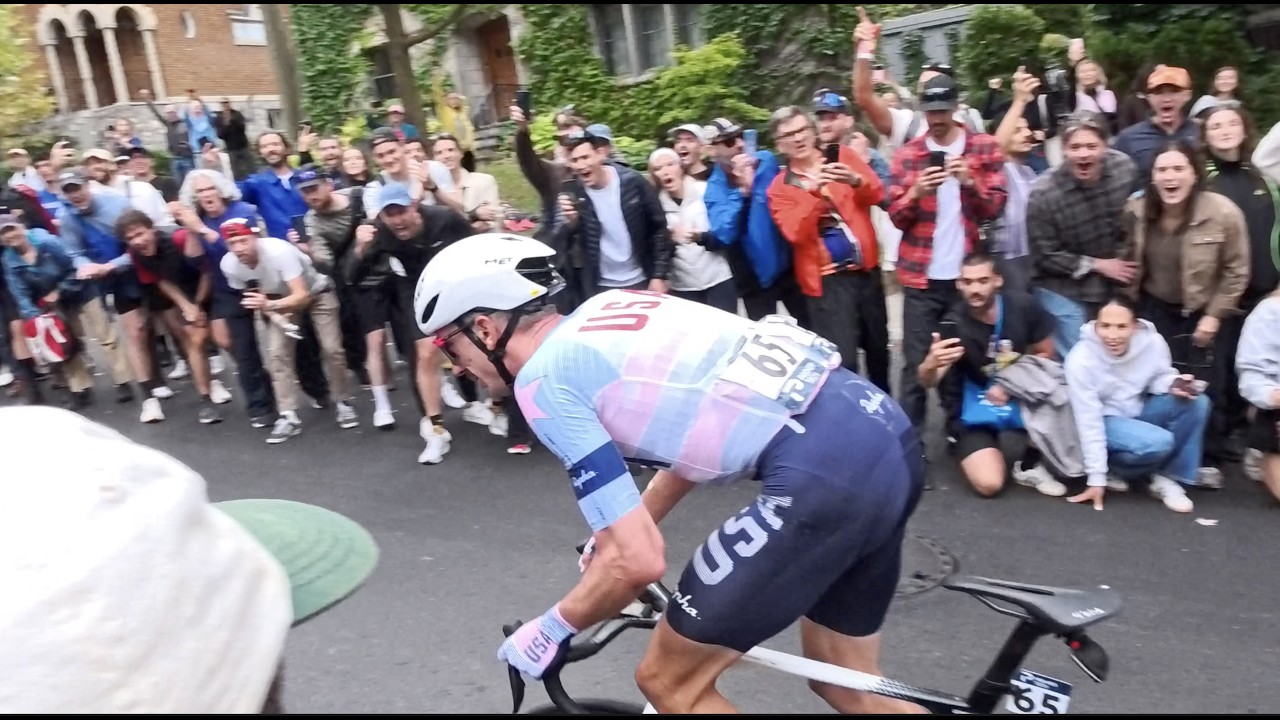
The third climb is the one I’ll remember. It goes up through a residential neighbourhood, and there were no fences. Fans lined the street on both sides right up to the edge of the tarmac, leaving the riders a narrow lane between them. This is where I got close to Brandon McNulty. He came up the street alone, in his USA kit, on the solo ride that made him the first American men’s world champion since 1993, and the whole street was screaming. That moment is the thumbnail of the video: McNulty filling the frame, and behind him a row of people with their mouths open and their phones up, some of them kneeling at the edge of the road to get closer.
Seixas, right in front of me
Then the lead group came through, and Paul Seixas cramped right in front of me. He had turned 20 three days earlier. He had taken bronze in the time trial earlier that week and finished second to Del Toro on these same roads at the Grand Prix, and France had spent the whole day riding for him. Then, on a residential street in Montréal, his legs gave out. On television, a rider getting dropped is just a gap opening on the screen. From a metre away, you see a real person whose body has stopped cooperating at the worst possible moment, with thousands of people shouting at him.
Thirteen days later he rode away from everyone on the Civiglio to win Il Lombardia, the youngest winner in the race’s history. I’ve watched the Montréal clip again since then. It’s a good reminder that even the best young rider in the world can have his legs give out on a hill in front of a stranger with a camera, and still win a Monument two weeks later.
In the grupetto
The grupetto of a race like this is the crowd. That means the people who claimed their spot on Camillien-Houde early in the day and kept it for all twelve laps, and the crowd at the university who made a bike race into a party. It means the residents of that unfenced street, who brought the world championship within arm’s reach. And it means everyone who cheered the last riders up each climb as loudly as the first. On the road there was Michael Woods, in the last race of his career, finishing 35th in front of his home country. There was Hugo Houle, who punctured early on his birthday and kept riding for the team. And there was Boivin, who led a World Championship through his own city for a hundred kilometres. Montréal cheered all of them, every lap.
Moral of the story
Television shows you who won. The roadside shows you everyone else: the crowd, the climbs, and a 20-year-old’s legs giving out in front of you. The grupetto’s moral: the best place to watch a bike race is wherever there’s no fence between you and the riders. Watch the video, then next time a race comes near you, go and stand on a hill.