A finale with teeth
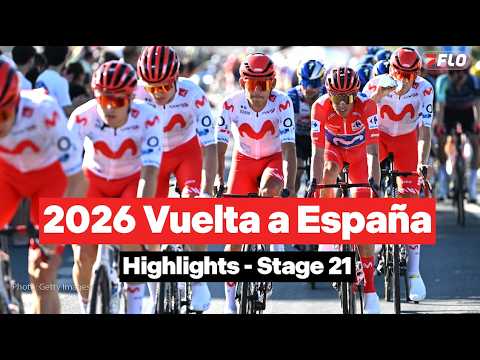
The organisers promised no ceremonial parade and stage 21 kept the promise: a flat loop through the Vega, then repeated laps of a Granada circuit crossing a kilometre of cobbles at 7.3% below the Alhambra, the line drawn just under the summit. Groupama-FDJ lifted the pace on the second ascent and a nine-rider break went clear; behind it, the peloton had one piece of business left, and it was concluded quietly on the final lap: with 9.8 km remaining, Enric Mas’s overall victory became mathematically safe, and a twelve-year weight came off Spanish cycling somewhere between two cobbled corners.
Johannessen finishes the weekend he started
At the front, the circuit did its work. Ramses Debruyne forced the decisive split inside 2 km — the young Belgian’s third top-three of the final week — with Tobias Halland Johannessen and Alessandro Romele the only ones able to follow, while Matthew Brennan faded on the cobbles and even Wout van Aert was dropped on the last ascent. On the false-flat run to the line, Johannessen came past Romele and won the sprint, a day after finishing second on the Alguacil and three weeks after his brotherly one-two behind Leknessund at Valdelinares. Uno-X leave their first Vuelta with two stages, a spell in the mountains jersey and the affection of every neutral. Romele’s fourth top-five of the race went unrewarded again; Debruyne, who made the move, was third in it.
Campeón
The record: Enric Mas wins the 2026 Vuelta a España by 2:15 over Primož Roglič and 2:44 over Felix Gall, with Richard Carapaz fourth and Sepp Kuss fifth after his Sierra Nevada raid. Wout van Aert takes green at a canter, Santiago Buitrago the mountains, Oscar Onley the white jersey. The context: the first Spanish winner of his home Grand Tour since Contador in 2014, Movistar’s first Grand Tour title since 2019, and Mas’s first after four podiums and a career spent as Spanish cycling’s designated nearly-man. He took the jersey the day Pogačar hit a rock outside Xeraco — an inheritance, the cynics said — and then made every mountain in Spain answer for it: the Aitana, Calar Alto, the Pandera, Peñas Blancas, the Alguacil. Nobody dropped him for three weeks. Inheritances don’t survive twelve summit finishes. Champions do.
The race in one paragraph
A Vuelta that began with 0.09 seconds in Monaco and lost its favourite to a pebble on a flat road became, improbably, one of the best in years: Brennan’s five sprints and Van Aert’s seven-win Visma machine, a cancelled stage in the hail, gravel and a ditch in Castellón, Uno-X’s black armbands, a 20-year-old alone at Calar Alto, Landa’s farewell queen stage, and a Spaniard in red under the Alhambra. 142 riders of the 184 who left Monaco made it to Granada. Every one of them finished the same race Mas won, which is the whole point of this website.
In the grupetto
The last autobus of the season’s last Grand Tour rolled up the cobbles four times and got its finisher’s applause, as is right. The grupetto’s final honours: to Bryan Coquard, whose Xeraco win on the race’s darkest day deserved a kinder news cycle; to Jordi Meeus, patron saint of second places; to the Uno-X brothers-in-arms; to Hugo Houle and the heat casualties who didn’t make Granada; and to Enric Mas — who spent years being told he was the best rider never to win one of these, and who is now, permanently, not that. See you at the Worlds in Montréal.
Moral of the story
Mas didn’t win this Vuelta the day Pogačar crashed; that day only made it possible to lose it in twelve new ways, daily, with a nation watching. He declined every one of them. The grupetto’s moral: luck opens the door once — staying through three weeks of mountains is character, and character is the only thing a GC actually measures. Twelve years, four podiums, one pebble, zero cracks. Campeón de España, campeón de la Vuelta. The road to next August starts tomorrow.